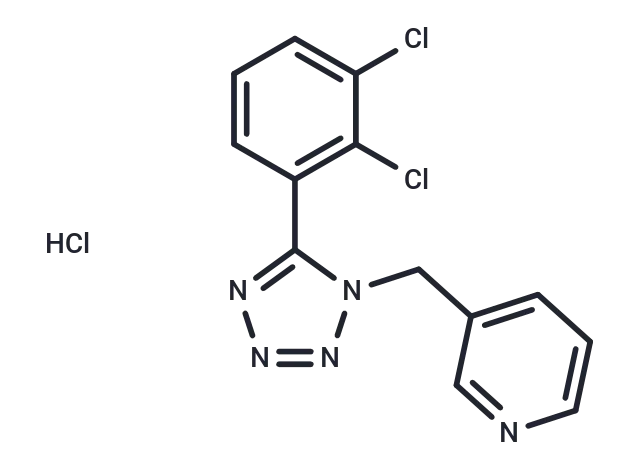
– A 438079 hydrochloride (A-438079 HCl) is a potent and selective P2X7 receptor antagonist with pIC50 of 6.9.
Web ID
– T2673
Storage Temperature
– -20℃
Shipping
– Blue Ice
Molecular Formula
– C13H10Cl3N5
Citations
– 1. Wang J, Han Y, Wang M, et al. The inhibitory effect of Yam polysaccharides on acrylamide‐induced programmed cell death in RAW 264.7 cells. Food Science & Nutrition. 2022
2. Su Q, Tian Y, Liu Z, et al. Purinergic P2X7 receptor blockade mitigates alcohol-induced steatohepatitis and intestinal injury by regulating MEK1/2-ERK1/2 signaling and egr-1 activity. International Immunopharmacology. 2019 Jan;66:52-61
3. Zhang A, Jin D, Han Y, et al.The effects of Yam polysaccharides on acrylamide-induced RAW264. 7 cell polarization.Journal of Food Bioactives.2023, 23.
References
– McGaraughty S, et al. Neuroscience. 2007, 146(4), 1817-1828.
Disclaimer: All products are for Research use only unless clearly stated otherwise on the product datasheet. Datasheets provided on the website are drafts for reference purpose only and you are requested to always refer to the hard copy included in the kit for your experimentation. Agdia Products are available for delivery only in Canada.